Choosing the right Bolt & Washer is a sourcing decision, not a simple catalog exercise. A joint may look correct and still fail under vibration, corrosion, or repeated loading.
Grand View Research reports that the global fasteners market continues to expand, driven by construction, automotive, energy, and industrial equipment. This growth increases supplier options. It also increases specification risk. Buyers must compare grade, thread system, coating, dimensions, hardness, traceability, and packaging—not only unit price.
The Industrial Fastener Institute stresses that fastener performance depends on the complete assembly. Bill Eccles, a recognized fastening-technology consultant and author of Bolt Science, has stated, “There is no such thing as a standard bolt.” That warning deserves attention. A metric bolt is not automatically interchangeable with an inch-series bolt. A zinc-plated washer may also perform poorly in a coastal environment.
Standards provide a reliable starting point. ISO 898-1 supports mechanical-property requirements for carbon-steel and alloy-steel bolts. ASTM F3125 covers structural bolts used in demanding connections. For washers, buyers should verify dimensional standards, material compatibility, surface treatment, and load distribution.
Do not trust photographs alone.
A practical sourcing review should connect the drawing, application, standard, inspection plan, and supplier certificate. Request sample measurements, coating thickness records, hardness results, and lot traceability. I have seen low-cost substitutions create expensive delays because the washer outside diameter did not properly support the joint.
Perfect sourcing checklists do not exist. Conditions change. A careful buyer leaves room for technical review, independent testing, and uncomfortable questions before approving mass production.
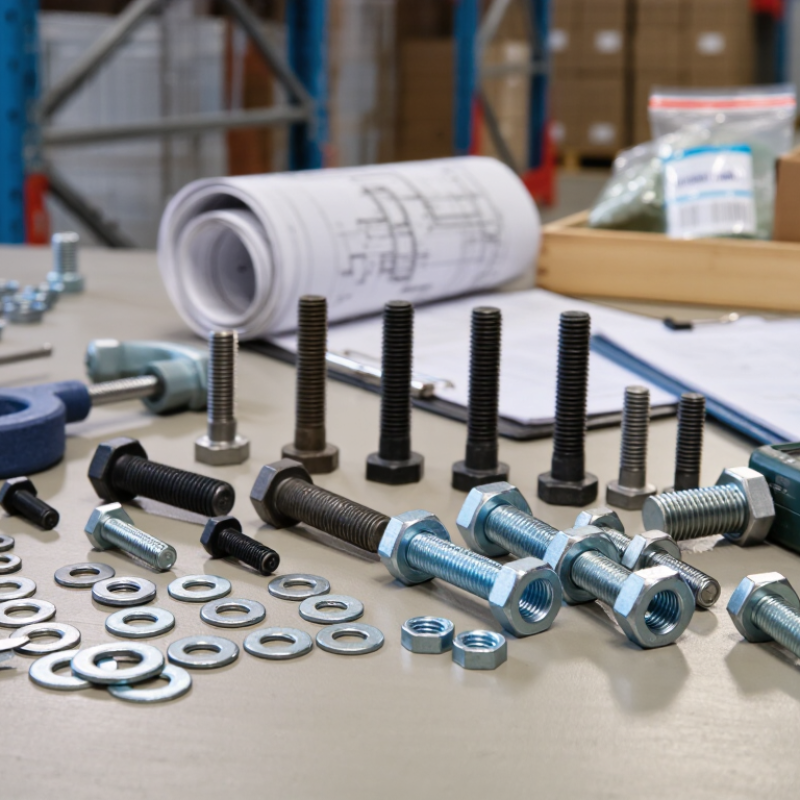
Before sourcing a bolt and washer, define the application clearly. Record the joint load, vibration level, temperature range, and available space. A roof panel, engine mount, and outdoor handrail need different fastening requirements. Do not rely on a bolt diameter alone. Thread size, pitch, length, and head style also affect performance. A short drawing with tolerances prevents costly interpretation errors.
Choose materials and finishes for the actual environment. Carbon steel may suit dry indoor equipment, while stainless steel can support damp applications. However, material compatibility matters. Dissimilar metals may increase corrosion risk. Select a washer that matches the bolt, hole size, bearing surface, and clamping method. A hardened washer may help under high loads. A sealing washer may suit exposed joints, but it can change compression behavior. Test the complete assembly, not separate parts only.
Global sourcing requires measurable specifications. State the required standard, mechanical grade, thread tolerance, coating thickness, and inspection documents. Ask suppliers for material certificates and sample measurements. Check thread engagement with a real mating part. It sounds basic. Many failures begin there. Packaging also deserves attention, especially where moisture, mixed sizes, or damaged threads are possible. I have seen well-written specifications miss washer hardness and installation torque. That omission looked minor until joint loosening appeared in field tests. Leave room for review after testing, because the first requirement set is rarely perfect.
| Requirement | Recommended Specification | Typical Selection Data | Global Sourcing Guidance | Acceptance Criteria |
|---|---|---|---|---|
| 1. Application and Load Definition | ||||
| Joint function | Specify whether the joint is structural, general-purpose, vibration-sensitive, or exposed to weather. | Examples: equipment frame, machine guard, outdoor enclosure, automotive support, or maintenance access panel. | Use the same functional description, drawings, and inspection requirements for every supplier. | The supplied assembly must meet the application drawing and documented performance requirements. |
| Load type | Define tensile, shear, bending, cyclic, impact, and vibration loads. | Record maximum working load, peak load, load direction, and number of operating cycles. | Do not select a bolt from diameter alone; confirm the required strength and joint design. | Design calculations or engineering approval confirm that the selected fastener is suitable. |
| Safety factor | Set the required design factor according to the applicable engineering code and risk level. | Use the project specification or local regulatory requirement; there is no single universal value. | State the design factor in the purchase specification so suppliers do not make different assumptions. | Calculation package and material certificates support the specified design basis. |
| 2. Bolt Selection | ||||
| Nominal diameter | Select a metric nominal diameter based on load, available edge distance, hole size, and installation access. | Common general-purpose sizes: M6, M8, M10, M12, M16, and M20. | Use the same nominal diameter and thread designation on drawings, purchase orders, and inspection reports. | Measured major diameter and thread gauge result conform to the specified metric thread. |
| Thread designation | Use ISO metric coarse thread unless a fine thread is technically required. | M10 × 1.5, M12 × 1.75, and M16 × 2.0 are common coarse-thread examples. | Always state diameter, pitch, and tolerance class; “M10 bolt” alone is incomplete. | Thread pitch and fit are verified using calibrated gauges or an approved measurement method. |
| Thread tolerance | Specify ISO metric external thread tolerance, commonly 6g for standard bolts. | Typical mating internal thread tolerance: 6H, unless the design specifies another class. | Confirm the supplier can provide inspection records for thread tolerance and functional fit. | The bolt passes the specified GO/NO-GO gauge or dimensional inspection. |
| Strength grade | Specify an ISO 898-1 property class for carbon or alloy steel bolts. | Property class 8.8: nominal tensile strength 800 MPa and nominal yield ratio 0.8. Property class 10.9: nominal tensile strength 1,000 MPa and nominal yield ratio 0.9. | Do not substitute a commercial grade, ASTM grade, or local designation without written engineering approval. | Head marking, material certificate, and mechanical test results match the specified property class. |
| Bolt length | Specify length from the bearing surface under the head to the end of the bolt for standard hex bolts. | Allow full nut engagement and avoid excessive thread protrusion. A common design target is at least one full thread beyond the nut after tightening. | Include grip length, washer thickness, nut height, and any coating thickness in the length calculation. | Installed joint has the specified grip, nut engagement, and thread protrusion. |
| Head and drive style | Choose a head type compatible with access, tool clearance, clamping surface, and installation method. | Common choices include hexagon head, socket head, countersunk, and flange head. | Define the applicable product standard and head dimensions rather than relying on a product photograph. | Head dimensions, bearing surface, and tool engagement conform to the approved drawing or standard. |
| Material | Use carbon steel, alloy steel, stainless steel, or another approved material according to load and environment. | Carbon or alloy steel is generally selected for high mechanical strength; stainless steel is selected for corrosion resistance but may have different strength and galling behavior. | Specify chemical composition, mechanical property class, and heat-treatment condition where applicable. | Material test certificate and independent verification, when required, match the purchase specification. |
| 3. Washer Selection | ||||
| Washer type | Use a plain washer for load distribution and surface protection; use a hardened washer where high bearing stress or high-strength bolting requires it. | Plain metric washers: ISO 7089 or ISO 7090. Large outside-diameter washers: ISO 7093-1. Hardened washers may be specified to a suitable engineering standard. | State the washer standard, nominal size, series, material, and hardness where relevant. | Outside diameter, inside diameter, thickness, flatness, and material conform to the specified standard. |
| Washer inside diameter | Select an inside diameter compatible with the bolt shank and the specified clearance-hole system. | Typical nominal inside-diameter examples: M6 washer approximately 6.4 mm; M8 approximately 8.4 mm; M10 approximately 10.5 mm; M12 approximately 13 mm; M16 approximately 17 mm; M20 approximately 21 mm. | Confirm the exact dimensional series before ordering because dimensions can vary by standard and product series. | The bolt passes through the washer without binding, while the washer remains fully supported on the joint surface. |
| Washer outside diameter | Choose a standard or large-series outside diameter according to the bearing area and substrate strength. | Large-series washers are useful for oversized holes, slots, thin sheet, soft materials, or reduced surface pressure. | Do not use a larger washer as a substitute for correcting poor hole design or inadequate edge distance. | Washer fully covers the hole and provides the specified bearing area without interfering with adjacent parts. |
| Washer thickness | Specify thickness according to the selected washer standard and joint compression requirements. | Standard and large-series washers have different thickness ranges; the exact value must be taken from the selected standard or drawing. | Include washer thickness in the grip-length and thread-engagement calculation. | Measured thickness is within the dimensional tolerance of the specified standard. |
| Washer hardness | Use a hardened washer when required to prevent embedment under a high-strength bolt or high clamping load. | Hardness requirements depend on the washer standard and joint design; specify a minimum hardness only when technically justified. | Avoid pairing a high-strength bolt with an inadequately supported soft washer in a high-load joint. | Hardness test results and dimensional inspection meet the approved specification. |
| 4. Hole, Joint, and Installation Requirements | ||||
| Clearance hole | Specify the hole diameter and tolerance according to the selected bolt diameter and fit requirement. | For general ISO metric clearance holes, typical nominal values include approximately 6.6 mm for M6, 9 mm for M8, 11 mm for M10, 13.5 mm for M12, 17.5 mm for M16, and 22 mm for M20. | Use the applicable hole standard or engineering drawing; precision, close, and large-clearance holes should not be mixed. | Hole diameter, roundness, burr condition, and alignment meet the approved drawing. |
| Joint surface | Define surface flatness, coating condition, roughness, and allowable gaps beneath the washer. | Remove burrs, weld spatter, loose scale, and contaminants from the bearing area. | State whether the bolt clamps painted, plated, machined, galvanized, or composite surfaces. | Contact surfaces are clean, stable, and capable of maintaining the specified preload. |
| Nut compatibility | Use a nut with the same nominal diameter, pitch, material compatibility, and strength requirement as the bolt. | For a property class 8.8 or 10.9 bolt, select a compatible nut property class according to the applicable fastener standard and joint design. | Specify the nut separately; do not assume that any nut with the same thread will provide the required performance. | Thread fit, nut height, material, and mechanical property are verified. |
| Installation torque | Specify a target preload or torque method, not torque alone, when joint performance is critical. | Torque depends on bolt diameter, thread pitch, preload, lubrication, coating, surface finish, and friction. There is no universal torque value for a given bolt size. | Require a torque table or calibrated torque-tension validation for the exact bolt, washer, nut, and lubricant combination. | Installation tools are calibrated and the achieved torque or preload is recorded when required. |
| Anti-loosening method | Select a locking method based on vibration, temperature, maintenance needs, and reuse requirements. | Options include prevailing-torque nuts, castellated nuts with pins, thread-locking compounds, safety wire, or engineered locking washers. | Do not use a locking device without checking its effect on preload, corrosion resistance, and installation sequence. | The specified locking method is installed correctly and passes the required functional test. |
| 5. Corrosion Protection and Global Compliance | ||||
| Operating environment | Classify exposure as dry indoor, humid indoor, outdoor, marine, chemical, high-temperature, or buried service. | Consider humidity, salt, chemicals, temperature cycling, galvanic contact, and expected service life. | Provide the same environmental classification to all potential suppliers before quotation. | Material and finish are approved for the documented service environment. |
| Surface finish | Specify the coating or finish, coating thickness where relevant, color, and corrosion-performance requirement. | Possible finishes include plain, electroplated zinc, zinc flake, hot-dip galvanized, phosphate, or stainless steel. Finish selection must match the environment and strength grade. | For high-strength bolts, verify hydrogen-embrittlement controls for electroplated finishes. | Coating type, thickness, appearance, adhesion, and corrosion test results meet the agreed specification. |
| Galvanic compatibility | Assess contact between dissimilar metals, especially in wet or salty environments. | Use compatible materials, insulating layers, or an approved protective system where galvanic corrosion is possible. | Specify the mating component material and environmental exposure, not only the fastener material. | No unacceptable galvanic corrosion risk is identified during design review. |
| Regulatory and chemical compliance | Define the regulations applicable to the destination market and end-use application. | Common requirements may include restricted-substance declarations, conflict-minerals reporting, safety documentation, and packaging regulations. | Ask suppliers for current declarations and maintain revision-controlled compliance records. | Required declarations and documentation are complete, current, and traceable to the supplied lot. |
| 6. Quality, Traceability, and Purchasing Data | ||||
| Applicable standard | List the exact product, dimensional, material, coating, and test standards required for the bolt and washer. | Examples include ISO 4014 or ISO 4017 for common hexagon-head bolts, ISO 898-1 for mechanical properties, ISO 7089 for plain washers, and ISO 7093-1 for large-series washers. | Use the full standard number and edition where relevant; avoid descriptions such as “standard bolt” or “regular washer.” | Supplier documents and product dimensions match every referenced standard. |
| Lot traceability | Require lot numbers linking raw material, heat treatment, coating, inspection, and shipment records. | Traceability should cover the bolt and washer separately when they are produced by different processes or suppliers. | Keep lot identification on packaging and quality documents throughout international transport and receiving. | Each shipment can be traced from the received lot to its material and inspection records. |
| Inspection plan | Define dimensional, visual, mechanical, coating, hardness, and functional inspection requirements. | Typical checks include thread gauge, diameter, length, head dimensions, washer dimensions, hardness, tensile testing, coating thickness, and surface defects. | Separate routine inspection from special tests required for safety-critical or high-volume applications. | Inspection records show conformity to the purchase specification and approved sampling plan. |
| Packaging and labeling | Specify packaging quantity, moisture protection, corrosion protection, lot identification, and handling instructions. | Labels should identify size, pitch, length, property class or material, finish, standard, quantity, and lot number. | Use clear metric labeling and avoid mixed sizes or mixed strength classes in one package. | Packaging protects the parts during global transport and labels are readable and complete. |
| Purchase-order description | Use a complete description containing size, pitch, length, head type, material or property class, finish, washer standard, quantity, and inspection requirements. | Example: “Hexagon-head bolt, M12 × 1.75 × 60 mm, ISO metric thread, property class 8.8, specified corrosion-protection finish, supplied with plain washer ISO 7089-12, inspection and traceability required.” | Attach the latest drawing and quality clause to prevent interpretation differences between countries. | Supplier order acknowledgement repeats all critical requirements without substitutions or omissions. |
Record joint load, vibration, temperature range, available space, thread size, pitch, length, and head style. A short drawing with tolerances prevents costly interpretation errors. Diameter alone is not enough.
A roof panel, engine mount, and outdoor handrail need different fastening requirements. Consider tension, shear, fatigue, preload, and repeated movement. Do not choose by price first.
Stainless steel may resist moisture, but it is not automatically stronger. Compare corrosion resistance, required strength, and galling risk. Dissimilar metals can accelerate corrosion. The cheaper option may cost more later.
A hardened washer can spread pressure beneath a high-strength bolt. It helps on soft steel or oversized holes. Match its inner diameter, hardness, and coating to the bolt system.
It may suit exposed joints where moisture entry matters. However, sealing material can change compression and tightening behavior. Test the complete assembly.
Request the applicable standard, mechanical grade, thread tolerance, coating thickness, and inspection documents. Ask for material certificates, sample measurements, coating records, and batch traceability. Paperwork helps. It proves less than a physical check.
Check thread engagement with a real mating part before production. Measure installation torque under actual lubrication and surface conditions. Correct grades can still fail after poor tightening.
Protect parts from moisture, mixed sizes, and damaged threads during shipment. Use clear labels and separate containers for different batches. Small packaging failures create large assembly delays.
No. The first requirement set may be incomplete. Review it after assembly tests, field observations, and inspection results. I have seen washer hardness and tightening torque overlooked. Those details later caused joint loosening.
Choosing the right Bolt & Washer combination for global sourcing begins with clearly defining the application’s load, operating environment, service life, assembly method, and applicable standards. Bolt material and grade should be matched to tensile and shear requirements, temperature, corrosion exposure, and compatibility with the connected materials. Washer selection is equally important: flat, spring, locking, or specialized designs can help distribute pressure, reduce surface damage, maintain clamping force, and improve joint reliability.
Before placing an order, verify dimensions, thread type, tolerances, strength markings, surface coatings, and international specifications. A dependable sourcing process should also evaluate supplier capabilities, material traceability, inspection procedures, testing records, and consistency between production batches. Packaging must protect parts from moisture, contamination, deformation, and mixing during transportation. Finally, review labeling, documentation, import requirements, and delivery arrangements to ensure the Bolt & Washer products arrive compliant, identifiable, and ready for safe use in the intended global application.

 Dongshuo Fastener